EUDR Compliance

Traceability Service

What makes this law different?

This legislation sets mandatory due diligence standards to level the playing field. The onus is on companies to prove that the relevant commodities are both deforestation-free and legal (compliant with all relevant applicable laws in force in the country of production). It is essential to have accurate data to prove that no deforestation has occurred after the cut-off date before shipments are made.

What you need to do for EUDR compliance?

  • Ensure that relevant commodities and products are deforestation-free & produced in accordance with the relevant legislation of the country of production

  • Companies are required to submit Due Diligence Statement – policies, controls and procedures to mitigate and manage effectively the risks of non-compliance

Amend / Withdraw Due Diligence Statement

DDS Integration with EU TRACES

  • Streamline workflow by pushing DDS data directly into EU TRACES from the Agridence Platform.

  • Geolocation data  pre-filled from the system instead of having to manually input geolocation data.

  • Independent audit function to check the internal policies, controls and procedures.

  • Keep 5-year records of Due Diligence Statement.

  • Risk assessments – documented, reviewed annually, and available upon request to authorities.

Get to know more about how:

  • Data is collected on the ground
  • Who collects the data
  • How data moves along the downstream
  • How risk analysis is performed
Agridence Logo

EUDR Country Risk Benchmarks

Key:

Low risk
Standard risk
High risk
No data

Country Risk Details

Data as of 22 May 2025. This information is for guidance only.

How can
Agridence help?

Our current userbase includes many of the tire makers who will need to comply with EUDR as the EU is a key market for them – we are in a unique position to provide common infrastructure and tools for them and their suppliers to comply to EUDR requirements​.

We develop tailored solutions to meet the industry’s needs and want to include EUDR and other relevant regulations into our solutions – our product suite touches on the physical trading and supplier data collection workflows which are critical elements for EUDR and other supply chain due diligence regulations.

Do reach out to us if you would like to find out more about our products.

Collect Upstream Data, Perform Risk Analysis,
Download Data for EU IS

Who collects the data?

There are 2 approaches:

Field-mapping services

  • Deployment of experienced, trained Agridence field team to map and verify the plantation polygons at the source using traceability app. Agridence partners with local field team that is experienced and is able to socialize the app and field mapping project to the local farmers.
  • Localization and socialization with farmers to educate them on the EUDR requirements
  • Conduct EUDR risk assessment surveys with the farmers

Processor/factory

  • Alternatively, mapping can be performed by trained personnel at farmer’s plantation on-site.
  • Processor to engage upstream supply chain for data collection

How data moves along the downstream

Transaction traceability through:

  • AgriTrace
    • Data collected from AGD’s traceability tool will be integrated with AGD’s traceability dashboard for
      users to track polygons mapped.
  • External Traceability Tool Integration
    • Data that was collected with an external traceability tool can be integrated for users to track polygons
      mapped.
  • Upload File with Polygon Data
    • User can upload an Excel file with the relevant information including the polygon data, allowing them to
      do a risk assessment over their polygon data.
  • Tagging of Polygon Data to SI
    • Users can link their plantation polygon data to the respective SI number/s associated with a trade on
      ARP.
    • Users can then view the polygons associated with each shipment.

How risk analysis is performed

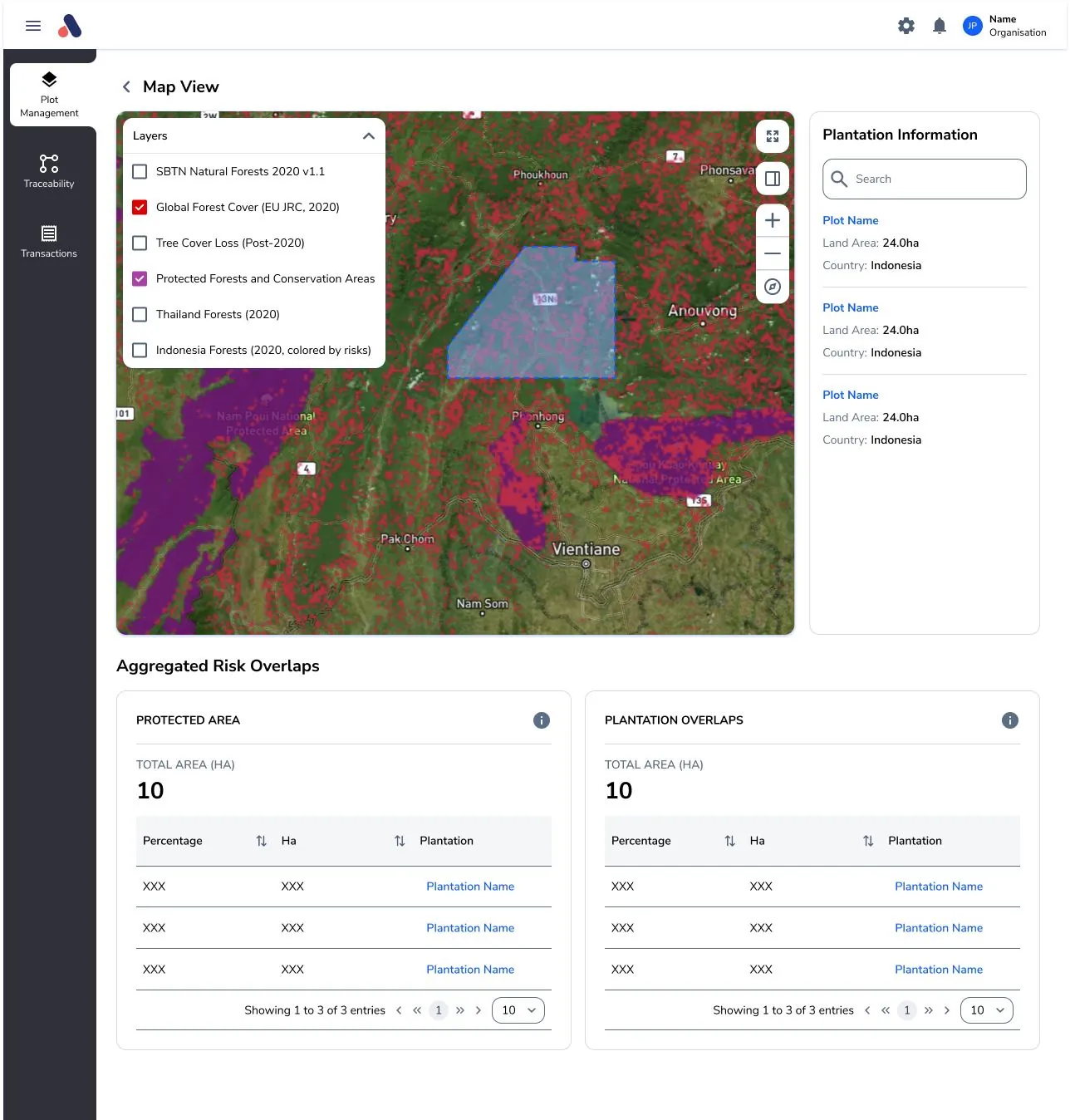
  • Agridence performs our risk assessment by overlaying risk layers with our customers’ polygon data. Plantations that overlap with one or more risk layers and/or other plantations will be flagged out as a plantation with risk. Therefore, it is important for plantations to be mapped as a polygon rather than a GPS coordinate.
  • How DDS is generated and data downloaded:
  • Users can generate and download a due diligence statement that they may share with their buyers/directly to the
    EU Information System.
  • Data fields with data from ARP will be automatically input. Remaining data can be input by the user before generating a DDS for download.
  • QR code to scan for verification purposes:
  • QR code with geojson coordinates of the plantations linked to the selected Sis.
  • Sample DDS

Embrace the future of responsible business with Agridence Rubber Platform – where innovation meets compliance, and sustainability is at the forefront of our technology.